October 27, 2026
To Santiago on foot:677 km and 918,000 stepson the Camino del Norte and Primitivo
Twenty-five stages, from a prologue in Switzerland on St James’ Day to the cathedral in Santiago de Compostela and on to Fátima — the coast on the Camino del Norte, the mountains on the Camino Primitivo, then Portugal. Every stage, start to finish.
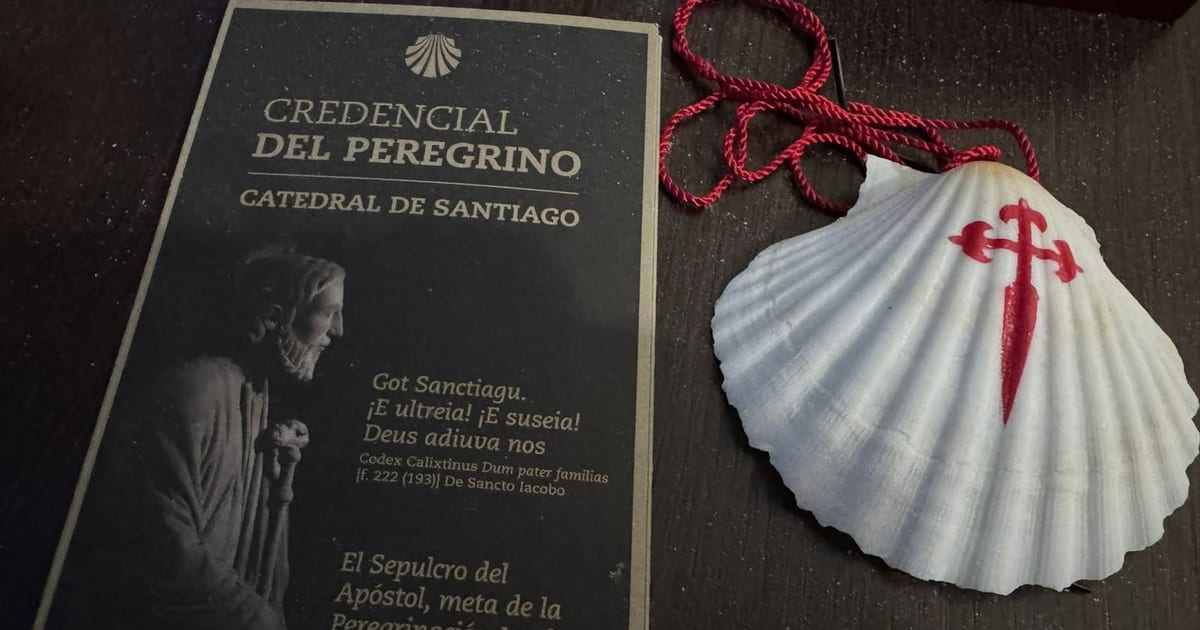
677 km. 918,000 steps. 16,822 m of climbing. 25 stages.
But the numbers are the least important part. Nel mezzo del cammin di nostra vita — at the close of a long chapter in my career, the Camino to Santiago became a time of introspection, meditation and rediscovered faith, and a clear mind for what comes next.
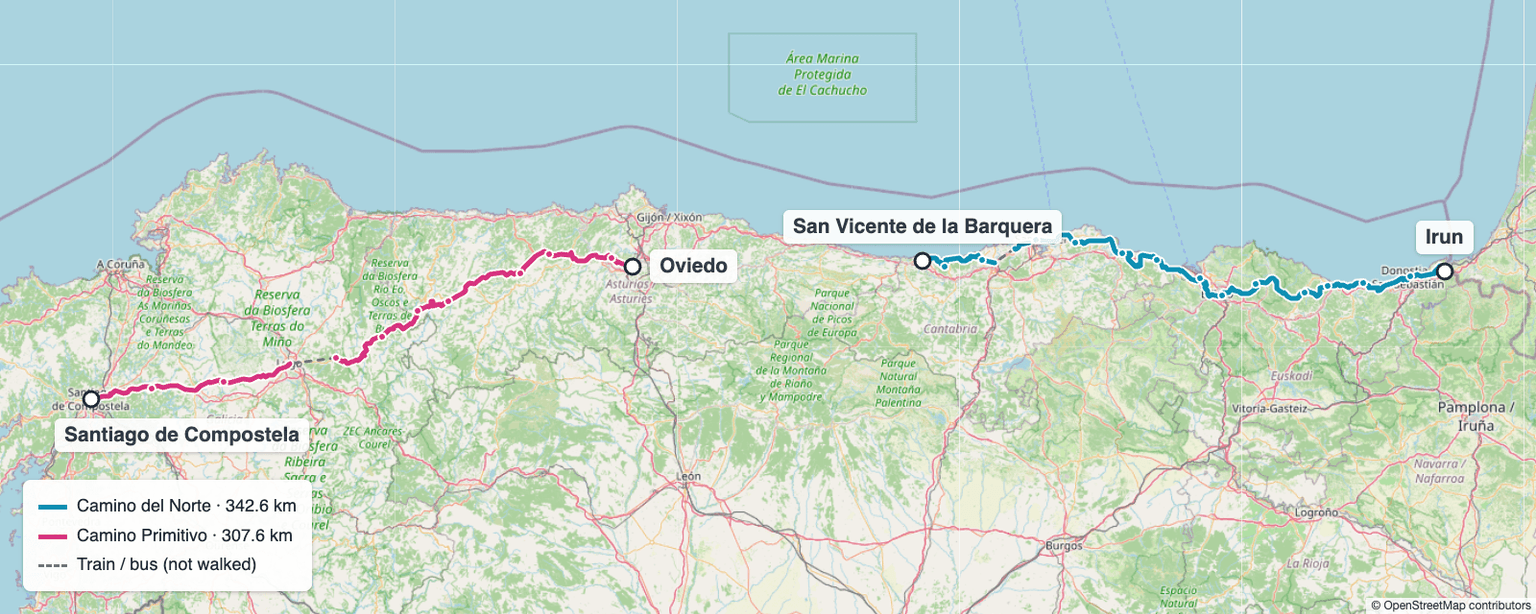
This summer I walked to Santiago de Compostela. I started at home in Switzerland on St James’ Day, then took the Camino del Norte from Irun along the coast, and halfway through switched to the Camino Primitivo, the oldest of the routes, which crosses the mountains of Asturias and Galicia. From Santiago the journey continued through Portugal to Fátima.
Every stage was recorded on a Garmin Forerunner 965 and synced to Strava. These are the numbers, and some of the photos.
The numbers
| Stage 0 | Camino del Norte | Camino Primitivo | Total | |
|---|---|---|---|---|
| Route | Münchwilen → Winterthur | Irun → San Vicente de la Barquera | Oviedo → Santiago | |
| Dates | 25 Jul | 28 Jul – 10 Aug | 11 – 20 Aug | |
| Stages | 1 | 14 | 10 | 25 |
| Distance | 26.5 km | 342.6 km | 307.6 km | 676.8 km |
| Ascent | 361 m | 8,129 m | 8,332 m | 16,822 m |
| Descent | 403 m | 8,194 m | 8,190 m | 16,787 m |
| Highest point | 658 m | 499 m | 1,227 m | 1,227 m |
| Time on the move | 4 h 51 min | 77 h 38 min | 65 h 17 min | 147 h 47 min |
| Average per day | 26.5 km | 24.5 km | 30.8 km | 27.1 km |
| Average heart rate | 115 bpm | 108 bpm | 109 bpm | 109 bpm |
| Energy (estimated) | 2,044 kcal | 30,376 kcal | 27,010 kcal | 59,430 kcal |
| Steps (estimated) | ~918,000 |
The Primitivo was shorter on paper and harder in practice: more climbing in 35 fewer kilometres, and a high point more than twice as high.
Heart rate zones
| Zone | Heart rate | Time | Share |
|---|---|---|---|
| Z1 | < 117 bpm | 107.7 h | 72.9 % |
| Z2 | 117–144 bpm | 37.3 h | 25.2 % |
| Z3 | 145–158 bpm | 2.5 h | 1.7 % |
| Z4 | 159–173 bpm | 19 min | 0.2 % |
| Z5 | ≥ 174 bpm | – | – |
Almost all of it in the two easiest zones: 98 % of 148 hours. The Camino is not a race; it is a long, steady effort, day after day. (I left out maximum heart rate: on a wrist sensor the few spikes above 170 on walking days are measurement noise, not effort.)
Stage 0: Münchwilen → Winterthur
The Camino starts at your own front door. Mine started on 25 July, the feast of St James: I parked the car in Münchwilen and walked 26.5 km back home to Winterthur.
The next morning, at St. Marien in Oberwinterthur, I had my shoes, my feet and my scallop shell blessed. That evening I took the train from Winterthur to Zurich airport and flew to Amsterdam, where a booking mistake left me an unplanned night before the flight to Biarritz the next day. From there it is a short hop across the border to Irun, where the Camino del Norte begins.
Camino del Norte: Irun → San Vicente de la Barquera
The Norte follows the Bay of Biscay through the Basque Country and Cantabria — beaches, fishing towns, and a lot more climbing than a coastal route suggests.
Select a stage number to see all its photos, or browse every stage.
| # | Date | From → To | km | ↑ m | ↓ m | Ø HR |
|---|---|---|---|---|---|---|
| 1 | 28 Jul | Irun → San Sebastián | 24.5 | 724 | 715 | 123 |
| 2 | 29 Jul | San Sebastián → Getaria | 30.8 | 725 | 678 | 120 |
| 3 | 30 Jul | Getaria → Mutriku | 23.9 | 1,077 | 890 | 112 |
| 4 | 31 Jul | Mutriku → Markina-Xemein | 19.1 | 587 | 829 | 115 |
| 5 | 1 Aug | Markina-Xemein → Morga | 35.2 | 1,029 | 936 | 114 |
| 6 | 2 Aug | Morga → Bilbao | 23.2 | 605 | 736 | 104 |
| 7 | 3 Aug | Bilbao → Portugalete | 25.2 | 556 | 638 | 97 |
| 8 | 4 Aug | Portugalete → Castro Urdiales | 32.2 | 563 | 498 | 106 |
| 9 | 5 Aug | Castro Urdiales → Laredo | 30.4 | 684 | 737 | 101 |
| 10 | 6 Aug | Laredo → Güemes | 24.1 | 237 | 164 | 96 |
| 11 | 7 Aug | Güemes → Santander | 16.0 | 218 | 229 | 93 |
| 12 | 8 Aug | Santander → Boo de Piélagos · Barreda → Santillana del Mar | 16.4 | 237 | 182 | 110 |
| 13 | 9 Aug | Santillana del Mar → Comillas | 26.8 | 648 | 651 | 111 |
| 14 | 10 Aug | Comillas → San Vicente de la Barquera | 14.9 | 239 | 311 | 106 |
Stage 12 has a gap on purpose: the bridge over the Ría de Mogro after Boo de Piélagos is railway-only, so the official route takes the train for that stretch, and I picked up the walk again at Barreda.
A radio interview in Pasaia
On the first morning, in Pasai Donibane, the village's parish priest was out on his morning walk — hiking clothes, poles, no habit — and walked part of the way with us, showing us the village. On the waterfront a reporter from a local radio station stopped him for an interview, and he talked about the Camino del Norte: "a bit more of a leg-breaker" than the Francés, but more varied, more rural, and a very rewarding experience.
The evening talk in Güemes
At the albergue in Güemes, after a dinner paid for by the donations of the pilgrims who had stayed the night before, its founder, the legendary Ernesto Bustio, 89 years old, stood up to speak. The room we were eating in, he said, was once his family's cow stable — and it is not a dining room but a museum, built from a journey through Africa and Latin America in the Land Rover parked outside. We arrive tired and hungry, he said, so we see only tables and food: we care a lot for the body and little for the spirit. Then he invited everyone to the small hermitage behind the albergue, where the paintings show the way of life, from manipulation to liberation — for him, the most important place on the whole Camino del Norte.
Camino Primitivo: Oviedo → Santiago
From San Vicente de la Barquera I moved to Oviedo and started the Primitivo at the cathedral. This is the route King Alfonso II is said to have walked in the 9th century: inland, over the Cordillera Cantábrica into Galicia, joining the Camino Francés at Melide for the final days.
Select a stage number to see all its photos, or browse every stage.
| # | Date | From → To | km | ↑ m | ↓ m | Ø HR |
|---|---|---|---|---|---|---|
| 15 | 11 Aug | Oviedo → Valsera (Las Regueras) | 13.6 | 376 | 364 | 112 |
| 16 | 12 Aug | Valsera → Salas | 38.6 | 929 | 921 | 113 |
| 17 | 13 Aug | Salas → Tineo | 19.5 | 753 | 350 | 112 |
| 18 | 14 Aug | Tineo → Berducedo | 42.5 | 1,498 | 1,280 | 114 |
| 19 | 15 Aug | Berducedo → San Julián (Grandas de Salime) | 27.1 | 858 | 1,099 | 106 |
| 20 | 16 Aug | San Julián → O Padrón (A Fonsagrada) | 25.8 | 841 | 612 | 117 |
| 21 | 17 Aug | O Padrón → Vilariño (Castroverde) | 33.7 | 926 | 1,224 | 106 |
| 22 | 18 Aug | Lugo → As Seixas | 34.2 | 794 | 643 | 102 |
| 23 | 19 Aug | As Seixas → Ferreiros (O Pino) | 38.4 | 763 | 1,016 | 101 |
| 24 | 20 Aug | Ferreiros → Santiago de Compostela | 34.3 | 594 | 679 | 108 |
Between stages 21 and 22 I took the bus for the last stretch from Castroverde into Lugo, about 20 km, and started again from the city.
Stage 18, from Tineo to Berducedo, was the toughest day of the whole walk: the longest (42.5 km), the most climbing (almost 1,500 m) and the highest point (1,227 m).
Beyond Santiago: Porto, Nazaré, Fátima, Lisbon
The pilgrimage did not end at the cathedral, but the walking did: this part was not on foot, and none of it is in the numbers above. From Santiago I travelled south through Portugal — Porto, then Nazaré, where I went back to running on the beach, then Fátima, and finally Lisbon.
At Fátima, in the Chapel of the Apparitions, I offered the shell — the one blessed in Oberwinterthur and carried all the way to Santiago — and the whole Camino to Our Lady of Fátima. For me, that was where the journey closed.
Afterwards
Twenty-five days, 677 km, and a lot of time to think with nothing to fix and nothing to deploy. I run, eat, pray and sleep, then repeat — the Camino was the same loop, just longer.
Every stage was recorded on Strava; my latest activities are on /runs.